
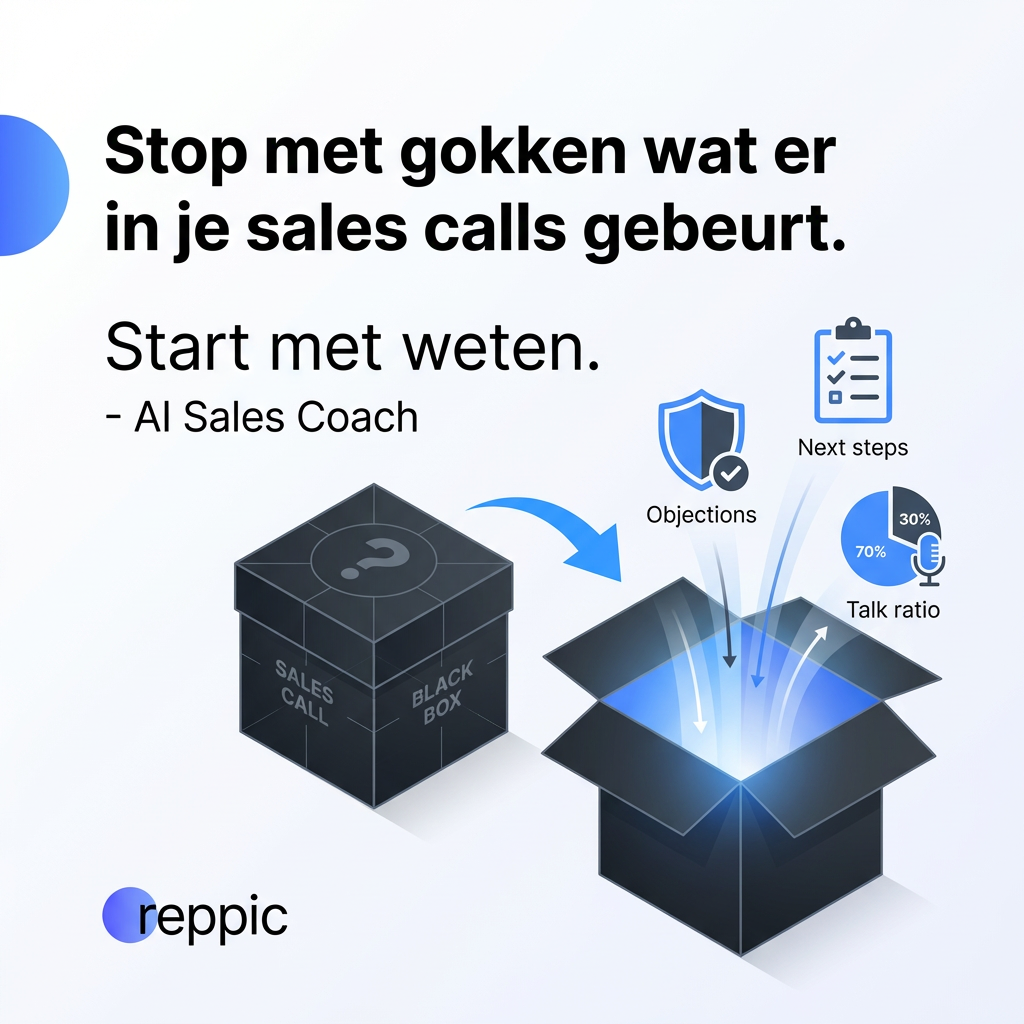
What if you could turn every sales call into a training session? Not just once a quarter, not in a conference room with a whiteboard—but right after every call, based on your actual experience.
This isn’t just a pipe dream. It’s what sales teams that consistently perform better are already doing today. And it starts with one honest question: are we actually training our salespeople in a way that works?
The well-known problem in sales
A sales director develops his strategy. It takes a lot of work. The goals are on point, the positioning is sharp, and the approach is clear. And then he hands it over to his sales team.
And then the black box starts.
Because what happens in the field after that? He doesn’t see it. He only sees the results afterward—in a CRM report, in quarterly figures, in a sales meeting. And by then, it’s too late to make adjustments. The question isn’t whether the strategy was sound, but whether the most was made of it. And you won’t know the answer until you understand what actually happened during those conversations.
At the same time, there’s something going on at the individual level. Salespeople have to perform every day. They have to give it their all every day, address objections, convince customers, and close deals. But training? They only do that once or twice a year. In a group setting, with role-playing exercises that don’t feel realistic—far removed from their daily work.
Compare that to a top athlete. They have talent—sometimes a lot of talent—but still train every day to get the most out of it. Their performance in competition is the result of daily practice, feedback, and growth. With salespeople, we flip that model on its head: we expect performance, but we don’t provide the training.
70% of professional development happens on the job
Australian scientist Charles Jennings developed the 70-20-10 model: 70% of professional development comes from learning by doing, 20% from guidance provided by managers and colleagues, and only 10% from formal training.
In practice, most organizations take the exact opposite approach. We allocate the budget to training sessions and hope that the knowledge sticks. But real growth comes from the work itself—from conversations with clients, from the moment an objection is raised, and from the way you handle follow-ups.
Imagine if you could capture that moment. Analyze it. And learn from it right away.
That is exactly the premise of Reppic.
From a black box to insight: conversation as the core
Reppic analyzes real sales conversations—whether through an app for in-person meetings or a note-taking tool for online calls. The conversation is at the heart of it all. Not a staged role-play, not a theoretical case study, but the actual conversation you just had with your client.
After each call, a sales representative receives:
- Personalized feedback on skills such as handling objections, asking the right questions, identifying customer types, and closing techniques
- Tailored videos that address his or her specific areas for improvement
- An AI Sales Trainer avatar that lets you practice the tricky parts of a conversation—in a safe environment, based on your own real-world experience
- An automatic meeting summary that you can share with your client right away, eliminating the need to write a visit report
That last point is more crucial than it seems. One of the biggest barriers to adoption is the question: “Are they monitoring me?” But if a salesperson automatically receives a professional report after every call—without having to type it themselves—then the initial reaction isn’t resistance. It’s relief.
Three levels, one goal
Reppic operates on three levels simultaneously:
1. The salesperson receives direct, personalized coaching based on their own interactions. No group averages, no assumptions. Concrete feedback, every day.
2. The sales manager gains insight into patterns within the team—not based on gut feelings, but on data. Where does the team get stuck when dealing with objections? What questions aren’t being asked? At what points does the team lose customers? These insights enable targeted coaching—and, as a result, genuine team development.
3. The director gains insight into the implementation of his strategy. Are the decisions made in the boardroom actually being carried out in the field? Is the gap between strategy and execution narrowing? Or does the strategy need to be adjusted?
Three levels. The same interview dates. A self-reinforcing cycle of growth.
Culture, not technology
It’s tempting to view Reppic as a technology product. But the technology is merely the enabler—the real work lies in the cultural aspect.
Because the question isn’t whether AI can analyze conversations. That question has already been answered. The question is: does an organization have the courage to be honest about what happens in those conversations?
This requires something from salespeople: the willingness to be visible and to grow. It requires something from managers: the ability to coach rather than micromanage. And it requires something from senior management: the courage to acknowledge that what happens on the ground may not always align with the strategy on paper.
Anyone who successfully integrates these three levels hasn’t just implemented a tool. They’ve built a learning organization.
The lone wolf is extinct
The traditional account manager—who works independently, closes deals through charm and personal networks, and keeps everyone else in the dark—no longer fits the modern sales landscape.
Customers are better informed than ever. They expect a sales representative who thinks proactively, understands their situation, and can see beyond their own area of expertise. This calls for a different kind of salesperson: someone who not only knows their product, but also their customer, their industry, and the challenges they face.
And paradoxically, as AI takes over more tasks, human relationships actually become more important—not less so. The digital paradox: greater automation means greater value for genuine connection.
That’s good news—for anyone willing to keep growing. And a strong message for those who aren’t.
Practice makes perfect
The great thing about the model Reppic enables is that it doesn’t place any extra burden on salespeople. You do your job. You have your conversations. And those conversations automatically become your training material.
Just as a top athlete analyzes every game to improve for the next one, Reppic analyzes every sales call to make the next one more effective.
No separate training session. No group session with role-playing exercises. No report that nobody reads anyway.
Simply put: work as daily training. Exactly how it should have always been.
Curious to see what Reppic can do for your sales team? Start a free 14-day trial.