
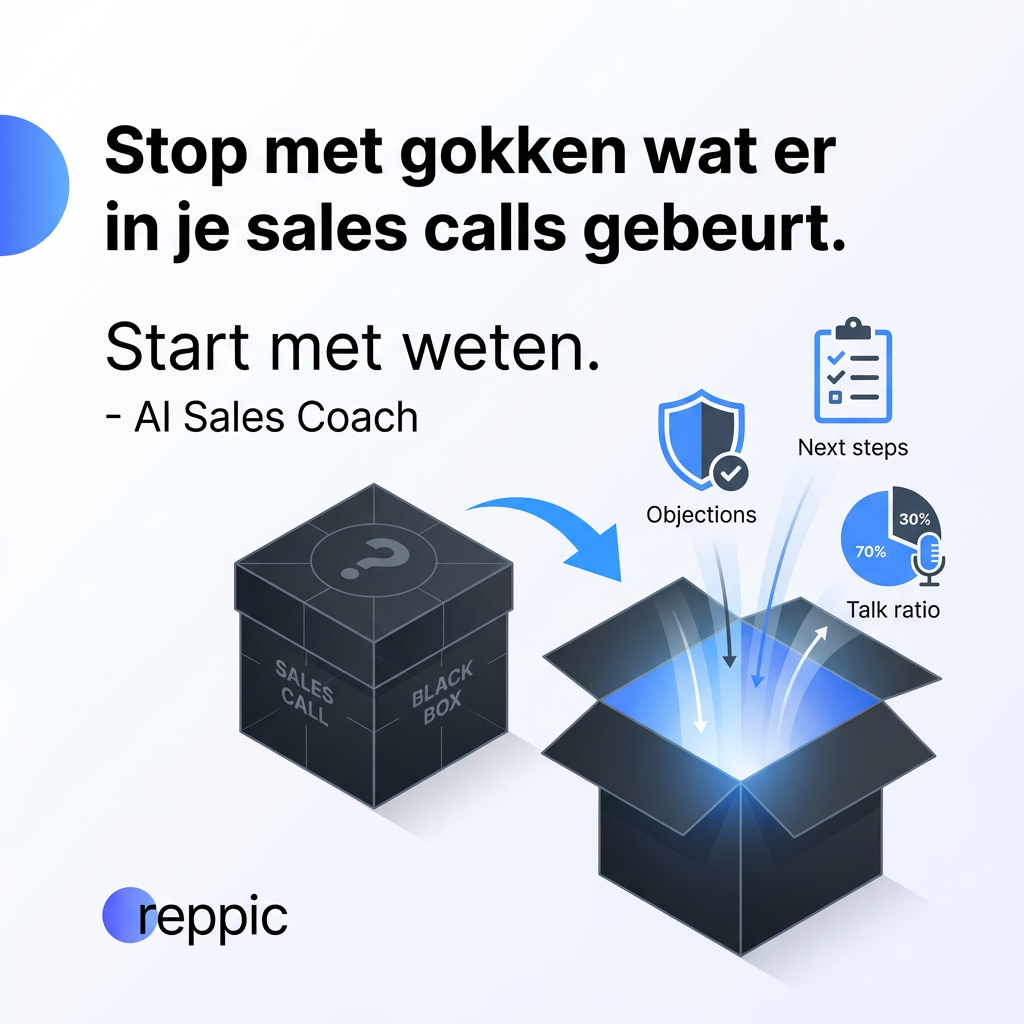
What if you could turn every sales conversation into a training session? Not once a quarter, not in a meeting room with a flip chart, but straight after every conversation, based on your real practice.
That is not a distant future. It is what structurally better-performing sales teams already do today. And it starts with one honest question: are we actually training salespeople in the way that works?
The familiar problem in sales
A sales director creates his strategy. A lot of work goes into it. The targets are right, the positioning is sharp, the approach is clear. And then he hands it over to his sales team.
And then the black box begins.
Because what happens in the field after that? He cannot see it. He sees the results afterwards: in a CRM report, in a quarterly figure, in a sales meeting. By then it is too late to adjust. The question is not whether the strategy was good, but whether the most was made of it. And you only get that answer when you know what really happened in those conversations.
At the same time, something is going on at an individual level. Salespeople have to perform every day. Every day they have to bring out the best in themselves, remove objections, convince customers, close deals. But training? They do that once or twice a year. In a group setting, with role-plays that do not feel realistic, far from daily practice.
Compare that with a top athlete. They have talent, sometimes a lot of it, but still train every day to get the most out of it. Performance in the match is the result of daily repetition, feedback and growth. With salespeople, we turn that model upside down: we expect the performance, but we do not provide the training.
70% of professional development happens in the work itself
The 70-20-10 model, which originated at the Center for Creative Leadership and was popularised by, among others, British learning expert Charles Jennings, states that 70% of professional development comes from learning by doing, 20% from guidance by managers and colleagues, and only 10% from formal training.
In practice, most organisations think exactly the other way round. We put the budget into training days and hope it sticks. But real growth happens in the work itself: in the conversation with a customer, in the moment an objection comes up, in the way you handle a follow-up.
Imagine you could capture that moment. Analyse it. And learn from it straight away.
That is exactly the starting point of Reppic.
From black box to insight: the conversation at the core
Reppic analyses real sales conversations, via an app for face-to-face meetings or via a notetaker for online calls. The conversation is the core. Not a staged role-play, not a theoretical case, but the real conversation you have just had with your customer.
After every conversation, a salesperson receives:
- Personal feedback on skills such as objection handling, questioning, recognising customer types and closing techniques
- Targeted videos that address his or her specific development points
- An AI Sales Trainer avatar to practise the difficult part of a conversation again, in a safe environment, based on your own practice
- An automatic conversation report that you can share with your customer straight away, so no visit report needs to be written any more
That last point is more crucial than it seems. One of the biggest barriers to adoption is the question: “Am I being monitored now?” But when a salesperson automatically receives a professional report after every conversation, without having to type anything, the first reaction is not resistance. It is relief.
Three levels, one goal
Reppic works at three levels at the same time:
1. The salesperson receives direct, personal coaching based on their own conversations. No group averages, no assumptions. Concrete feedback, every day.
2. The sales manager gains insight into patterns within the team. Not based on gut feeling, but on data. Where does the team get stuck on objections? Which questions are not being asked? At which points does the team lose customers? Those insights make targeted coaching possible, and with it real team development.
3. The director gets a view of how their strategy is executed. Is what was decided in the boardroom also what happens in the field? Is the gap between strategy and execution getting smaller? Or does the strategy need to be adjusted?
Three levels. The same conversation data. A growth loop that reinforces itself.
Culture, not technology
It is tempting to see Reppic as a technology product. But the technology is the enabler; the real work is cultural.
Because the question is not whether AI can analyse conversations. That question has already been answered. The question is: does an organisation dare to be honest about what happens in those conversations?
That asks something of salespeople: the willingness to be visible and to grow. It asks something of managers: the skill to coach instead of control. And it asks something of leadership: the courage to admit that execution in the field may not always match the strategy on paper.
Whoever brings those three levels together in the right way has not simply implemented a tool. They have built a learning organisation.
The lone wolf is extinct
The traditional account manager, who drives around on his own compass, brings in deals on charm and personal networks and lets nobody else look over his shoulder, no longer fits modern sales.
Customers are better informed than ever. They expect a conversation partner who thinks along with them, brings knowledge of their situation and can look beyond their own field. That calls for a different type of salesperson: someone who knows not only their product, but also their customer, their industry and their challenges.
And paradoxically, the more tasks are taken over by AI, the more important the human relationship becomes. Not less. The digital paradox: more automation means more value for real connection.
That is good news for everyone who is willing to keep growing. And a clear message for those who are not.
The work does the training
The beauty of the model that Reppic makes possible is that it puts no extra burden on a salesperson’s shoulders. You do your work. You have your conversations. And those conversations automatically become your training material.
Just as a top athlete analyses every match to make the next one better, Reppic analyses every sales conversation to make the next one sharper.
No separate training moment. No group session with role-plays. No report that nobody reads anyway.
Simply: work as daily training. Exactly as it should always have worked.
Curious what Reppic can do for your sales team? Book a 30-minute demo.